
Specified Skilled Worker/Technical Intern Training Visa
Change of Specified Skilled Worker System (for nursing care, Industrial product manufacturing, and food service fields)
- 2025.11.14

In response to the recent labor shortage, a cabinet decision was made on March 11, 2025 to change the field-specific operational policies of nursing care, Industrial product manufacturing, and food service fields of the Specified Skilled Worker Visa (Actual implementation will take place after the publication and enforcement of the additional notification, while, for the nursing care field, the additional standard notification was revised on April 21, 2025, and implementation has already begun.) This time, we will look at what changes have been made to these three fields!



Background of changes of Specified Skilled Worker System
The Specified Skilled Worker Visa was established in 2019 with the aim of resolving Japan’s labor shortage. Currently, it covers 16 industries in which labor shortages are particularly severe. As the industries covered are so diverse, the situation of labor shortage and required human resources vary from industry to industry. Therefore, the details of each industry are determined in the “field-specific operational policy” prepared by the Minister of Justice in collaboration with the heads of each relevant administrative agency, the National Public Safety Commission, the Minister of Foreign Affairs, and the Minister of Health, Labor and Welfare (see Article 2-4, Paragraph 1 of the Immigration Control and Refugee Recognition Act).
In addition, the field-specific operational policy must include:
(i)the industrial fields, which need to secure human resources to supplement the labor shortage through the employment of foreign nationals due to the difficulty in securing human resources, to be specified in the field-specific operation policy;
(ii)the particulars on the situation of the shortage of human resources in the industrial fields under the preceding item (including the situation of the region in which there is a shortage of human resources in the applicable industrial field);
(iii)the particulars on the criteria for the human resources required in the industrial fields of item (i);
(iv)the particulars on the measures for suspension of issuance of the certificates of eligibility or the measures for recommencement of issuance provided for in Article 7-2, paragraph (1) pursuant to the provisions of paragraph (3) and paragraph (4) of the same Article (including cases in which these provisions are applied mutatis mutandis pursuant to paragraph (5) of the same Article) in the industrial fields of item (i);
(v)in addition to those particulars set forth in each of the preceding items, important particulars on operation of the system pertaining to the “Specified Skilled Worker” status of residence in the industrial fields of item (i).
(See Article 2-4, Paragraph 2 of the Immigration Control and Refugee Recognition Act)
As mentioned above, the details of the requirements for each field regarding applicants, receiving organizations, etc. are set out in the field-specific operational policies.
In a cabinet decision made on March 11, 2025, changes were made to the field-specific operational policies to change the operation of the Specified Skilled Worker Visa in the nursing care, Industrial product manufacturing, and food service industries. Let’s take a look at what changes have been made to each of these fields.
Changes in nursing care field
What can be done with the visa
〇Specified Skilled Worker (i)(Activities to engage in duties that require skills for which a considerable degree of knowledge or experience)
・Physical care, etc. (bathing, eating, etc.)
・Recreational activities, rehabilitation assistance, etc.
・Related tasks (management of notices, replenishing and managing items, etc.)
〇Specified Skilled Worker (ii)(Activities to engage in duties which require expert skills)
None
Reason of changes of the system
What makes home care different from regular care is that it is basically one-on-one, so there is no supervision at the site. Therefore, in order to provide home care, it is necessary to have completed the initial care worker training course, the practical care worker training course, or to be a certified care worker. Due to the unique nature of home care, it was not permitted to work with a Specified Skilled Worker Visa.
However, there was a particularly severe shortage of personnel in home care, and many home care service providers were going bankrupt, so some kind of measure was urgently needed. In addition, in order for Japan to be chosen as an attractive place to work, there was a demand for a system that would allow foreigners to advance their careers by gaining experience in a variety of tasks, including home care.
Therefore, the nursing care field was revised to allow home care by foreigners with specified skilled worker visa.
Reference:
Minutes of the 7th meeting of the Study Group on the Work of Foreign Care Workers
https://www.mhlw.go.jp/content/001332263.pdf
Revision of existing field-specific operational polices for the Specified Skilled Worker System (Cabinet decision on March 11, 2025)
https://www.moj.go.jp/isa/content/001434993.pdf
Changed items
Based on the revision this time, foreign nationals with Specified Skilled Worker Visa are now allowed to work in home care services. However, in order to be able to work in home care, the following requirements are imposed on both foreign nationals and the institutions that accept them.
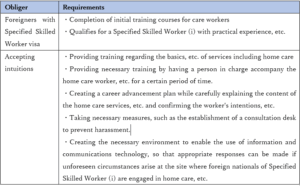
Policy on the operation of the system related to the status of residence for specified skilled worker in the nursing care field
https://www.moj.go.jp/isa/content/001434811.pdf
Changes in Industrial product manufacturing field
What can be done with the visa
〇Specified Skilled Worker (i)(Activities to engage in duties that require skills for which a considerable degree of knowledge or experience)
・Tasks (manufacturing, processing, molding, etc.) related to each sector (mechanical metal processing, electrical and electronic equipment assembly, metal surface treatment, paper and cardboard box manufacturing, concrete product manufacturing, RPF manufacturing, ceramic product manufacturing, printing and bookbinding, textile product manufacturing, sewing)
・Related work (procurement and transportation of raw materials and parts, operation of cranes, cleaning, maintenance management work)
〇Specified Skilled Worker (ii)(Activities to engage in duties which require expert skills)
・Tasks (manufacturing, processing, molding, etc.) related to each sector (mechanical metal processing, electrical and electronic equipment assembly, metal surface treatment)
・Related work (procurement and transportation of raw materials and parts, operation of cranes, cleaning, maintenance management work)
Reason of changes of the system
In a cabinet decision on March 29, 2024, the expected number of foreign nationals with Specified Skilled Worker Visa to be accepted in the fields of Industrial product manufacturing was changed. For 2019 to 2023, it was 49,750 people, but the number increased by more than threefold to 173,300 people for 2018 to 2024.
At the same time, the target work categories were also changed:
7 new categories (④ Paper container and cardboard box manufacturing, ⑤ Concrete product manufacturing, ⑥ Ceramic product manufacturing, ⑦ Textile product manufacturing, ⑧ Sewing, ⑨ PRF manufacturing, ⑩ Printing and bookbinding) were added to the previous 3 categories (① Mechanical metal processing, ② Electrical and electronic equipment assembly, ③ Metal surface treatment), making the number of available work categories 10.
In order to respond to such a major change, it became necessary to improve the acceptance system.
In addition, the operation of skill evaluation tests in the industrial product manufacturing field had been carried out by the Ministry of Economy, Trade and Industry, but since the operation was to be transferred to a private organization, it became necessary to establish such a private organization.
Due to the need to develop such a system, a change to a field-specific policy was made by a Cabinet decision in March 2025. (Actual implementation will take place after the promulgation and enforcement of the additional standards, etc.)
Changed items
In the industrial product manufacturing field, new obligations were created by a cabinet decision in March 2025. The details are as follows:
|
Obligor |
Added obligations |
|
Manufacturing industry associations, etc. |
・Jointly establish an organization to carry out ① and ② ① Formulating joint rules to realize proper and smooth acceptance of foreign nationals with Specified Skilled Worker Visa in the manufacturing industry and confirm compliance ② Coordination with local institutions overseas, securing locations for skill tests, conducting tests, recruiting test takers, etc. |
|
Accepting Institutions |
・Initiatives to improve productivity and secure domestic human resources ・Belonging to the above-mentioned newly established organization ・Taking measures agreed upon at the “Consultation and Liaison Committee for Acceptance of Foreign Nationals of Specified Skilled Worker in Manufacturing” ・Providing necessary cooperation with general guidance, collection of reports, requests for materials, hearing opinions, on-site investigations, and other operations conducted by the Ministry of Economy, Trade and Industry, etc. ・Provide training and various courses for foreign nationals with specified skills as necessary ・Providing written documentation certifying practical experience upon request from foreign nationals with Specified Skilled Worker Visa (These changes will be applied after a certain period of time has passed as determined by the Ministry of Economy, Trade and Industry) |
Changes in food service field
What can be done with the visa
〇Specified Skilled Worker (i)(Activities to engage in duties that require skills for which a considerable degree of knowledge or experience)
・Cooking (preparing ingredients, plating, etc.)
・Serving customers (guiding customers to their seats, taking orders, receiving payment, handing over products, responding to complaints, etc.)
・Store management (general hygiene management, shift management, employee guidance and training, customer information management, cash register and ticket machine management, accounting management, liaison and coordination with the company headquarters, trading companies, and the government, maintenance of various equipment and facilities, ordering ingredients, etc., menu planning and development, advertising planning, creating and revising work manuals, etc.)
・Related duties (production of agricultural, forestry, and fishery products used in the store, sales of items other than cooked foods, etc.)
〇Specified Skilled Worker (ii)(Activities to engage in duties which require expert skills)
・Cooking (preparing ingredients, plating, etc.)
・Serving customers (guiding customers to their seats, taking orders, receiving payment, handing over products, responding to complaints, etc.)
・Store management (general hygiene management, shift management, employee guidance and training, customer information management, cash register and ticket machine management, accounting management, liaison and coordination with internal headquarters, clients, government, etc., maintenance of various equipment and facilities, ordering of ingredients, etc., menu planning and development, advertising planning, creation and revision of work manuals, etc.)
・Business management (Store management analysis, business management, contract-related affairs, etc.)
・Related duties (production of agricultural, forestry, and fishery products used in the store, sales of items other than cooked foods, etc.)
Reason of changes of the system
https://www.keishicho.metro.tokyo.lg.jp/tetsuzuki/fuzoku/gyoshu_ichiran.html)
First of all, the purpose of the Act on Control and Improvement of Amusement Business (hereinafter referred to as the “Amusement Business Act“) is “maintaining public morals and wholesome social environment and preventing acts that hamper the sound development of youths” (Article 1 of the same Act); therefore, it requires permission for certain businesses that may affect good morals, etc. For example, cabarets and snack bars that provide direct entertainment, bars that serve alcohol late at night, game centers, and sex entertainment businesses must obtain permission under this Act (see Articles 2 and 3).
(See the Metropolitan Police Department List of Amusement Businesses, etc.
https://www.keishicho.metro.tokyo.lg.jp/tetsuzuki/fuzoku/gyoshu_ichiran.html)
In order to ensure a safe working environment, foreign workers with Specified Skilled Worker Visa for the food service industry were not allowed to work at establishments that were licensed under the Amusement Business Act. However, this has been inconvenient, as it banns foreign workers to work in not only in bars and snack bars, but also in the kitchens, dining areas, banquet halls, etc. of many inns and hotels. (Many inns and hotels provide services of “entertaining customers” such as pouring drinks, and therefore many of them are subject to licenses under the Amusement Business Act.)
In this situation, after the COVID-19 pandemic passed and inbound demand rapidly recovered, the food and beverage departments of accommodation facilities fell into a serious labor shortage, so inn and hotel industry groups called for the relaxation of work location restrictions.
Changed items
As mentioned above, in the food service field of the Specified Skilled Worker System, foreigners with Specified Skilled Worker Visa were not allowed to work in inns and hotels with permission based on the Amusement Business Act before the revision. However, due to a cabinet decision made on March 11, 2025, even inns and hotels with permission based on the Amusement Business Act became able to engage in food and beverage-related work if they have obtained permission under the Hotel Business Act (Article 3, Paragraph 1) for “hotel business (Article 2, Paragraph 1 of the Hotels Business Act)” (i.e. business that sets up facilities and provides lodging to people in exchange for lodging fees). (Actual implementation will take place after the promulgation and enforcement of the additional standards, etc.)
The table below shows the comparison before and after the change.
|
Inn, hotel |
Service |
Before change |
After change |
|
|
Permission under Amusement Business Act |
Permission under Hotel Business Act |
|||
|
Obtained |
None |
Serving customers |
✕ |
✕ |
|
Cooking |
✕ |
✕ |
||
|
Store management |
✕ |
✕ |
||
|
Entertaining customers |
✕ |
✕ |
||
|
Obtained
|
Obtained |
Serving customers |
✕ |
〇 |
|
Cooking |
✕ |
〇 |
||
|
Store management |
✕ |
〇 |
||
|
Entertaining customers |
✕ |
✕ |
||
|
None |
None |
Serving customers |
〇 |
〇 |
|
Cooking |
〇 |
〇 |
||
|
Store management |
〇 |
〇 |
||
|
Entertaining customers |
✕ |
✕ |
||
|
None
|
Obtained |
Serving customers |
〇 |
〇 |
|
Cooking |
〇 |
〇 |
||
|
Store management |
〇 |
〇 |
||
|
Entertaining customers |
✕ |
✕ |
||
(✕=Cannot be operated, 〇=Can be operated)
As mentioned above, please be aware that “entertaining customers” is prohibited under the Amusement Business Act.
The Amusement Business Act defines “entertaining customers” as “to treat customers in a manner that creates an amusing atmosphere.” (Article 2, Paragraph 3), and a notification further explains it as “engaging in conversation or providing services to a specific customer or group of customers that go beyond the provision of services normally associated with simply eating and drinking.”
Specifically, the following acts constitute “entertaining customers.”
・Continuously chatting with a small number of customers, pouring drinks, etc.
・Presenting or having a show, etc., performed in a guest room, etc., performed for a small number of customers
・Standing close to a small number of customers, encouraging them to sing, clapping, applauding, or praising their singing, and singing along
・Acting with a small number of customers and making them dance while touching their bodies
・Standing close to a small number of customers without touching them physically, and dancing with them continuously
・Playing games, competitions, etc. with a small number of customers
・Bringing close physical contact with customers, touching their bodies by holding their hands, etc.
・Placing food and drink up to the customer’s mouth and making them eat and drink
Please be careful as the difference between entertaining customers and serving customers can be subtle.
Reference:Regarding the interpretation and application of the Act on Control and Improvement of Amusement Business, etc.(Notification)
https://www.npa.go.jp/laws/notification/seian/hoan/hoan20180130.pdf)
Summary
A cabinet decision on March 11, 2025 allowed foreign nationals with Specified Skilled Worker Visa to work in home care for the nursing care field, and in the food service field, foreigners became able to work in inns and hotels that have obtained permission under the Amusement Business Act and the Hotel Business Act. In addition, in the industrial product manufacturing field, the system has been improved in response to the increase in the expected number of accepted foreigners and the target work categories.
In this way, the fields in which foreign nationals with Specified Skilled Woker Visa can work are expanding. However, there have been many revisions to the system, and the system content is complicated, so it may be difficult to understand what kind of work are within the scope. If you are considering obtaining a Specified Skilled Worker Visa, or if you are a company considering accepting foreign nationals with Specified Skilled Worker Visa, please feel free to contact us.
Reference:
Job Description of Specified Skilled Worker (i)
https://www.moj.go.jp/isa/applications/ssw/10_00179.html
Revision of existing field-specific operational polices for the Specified Skilled Worker System (Cabinet decision on March 11, 2025)
https://www.moj.go.jp/isa/content/001434993.pdf
Editor of this article
- Ryota Yanagimoto
- Administrative Scrivener/Judicial Scrivener
At the age of 24, he passed the national examinations for judicial scrivener, administrative scrivener, and wage service manager at the same time.
While working as a full-time lecturer at a major prep school, he independently opened a legal office related to judicial scriveners and administrative scriveners,
and he has experience as a judicial scrivener and an administrative scrivener for more than 15 years so far.
He has been actively contributing to various industries such as publicly listed companies, real estate companies, financial institutions, elderly care services, and professional organizations by conducting seminars, lectures, and talks.
And now he has a record of over 60 presentations so far.
Furthermore, as the president of a Japanese language school announced by the Ministry of Justice and Acts, and an advisor to a real estate company (capable of handling foreign clients),
he has been involved in various aspects of industries related to foreigners.
It is recommended to consult with experts when it comes to visas, naturalization, and residency matters.

Our office has specialized experts in visa and naturalization applications who are available to assist with free consultations (limited to the first session) and inquiries related to various visa applications and naturalization applications.
Additionally, we have foreign staff proficient in English, Chinese, and Korean languages with specialized knowledge, and they are present to provide support. They can accommodate consultations and inquiries in each language. Feel free to use our free consultation and inquiry services from here.